Virtual Reality and Artificial Intelligence; The Future of Intelligent Experiences
Virtual Reality and Artificial Intelligence
Introduction
Combining Two Technologies to Create Intelligent Digital Experiences
Virtual Reality (VR) and Artificial Intelligence (AI) are two transformative technologies whose combination can shape a new generation of digital experiences. Virtual reality brings users into three-dimensional and simulated environments, while artificial intelligence transforms these environments from static spaces into dynamic and interactive experiences through information analysis, learning from user behavior, and intelligent decision-making.
In the past, virtual reality environments focused more on displaying three-dimensional images and simulating real-world environments. However, today, with the introduction of artificial intelligence, these environments can analyze user behavior, respond to their requests, and change their content according to each person's needs. This transformation has created a new path for education, entertainment, commerce, communication, and organizational activities.
Pishgaman Lotus, by focusing on the development of software solutions and artificial intelligence, considers this technological convergence one of the important areas for transforming digital experiences and intelligent services.
How Do Virtual Reality and Artificial Intelligence Combine?
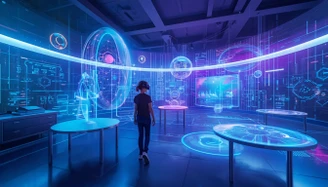
Virtual reality uses headsets, controllers, and motion-tracking equipment to create a digital environment in which users can be present and interact with different elements. In contrast, artificial intelligence is responsible for analyzing data, identifying patterns, and creating intelligent responses.
The combination of these two technologies means that virtual environments are no longer merely a collection of pre-designed images. For example, a virtual character can answer user questions using language models, an intelligent trainer can evaluate an individual's skill level, and an educational environment can change learning stages based on the user's performance.
On the other hand, machine learning algorithms can analyze information related to users' movements, choices, and interactions. This information helps the system provide a more suitable and personalized experience.
In such a structure, virtual reality provides the interaction platform, while artificial intelligence gives this interaction meaning, flexibility, and decision-making capabilities.
Personalized Experiences in the Virtual World
One of the most important capabilities of combining artificial intelligence and virtual reality is creating personalized experiences. In traditional virtual reality environments, users usually encounter the same content; however, artificial intelligence-based systems can examine the behavior and preferences of each user and adjust the environment according to their needs.
For example, in a virtual reality game, artificial intelligence can change the difficulty of stages based on the player's performance. In an educational environment, the system can identify the subjects in which a student is weak and provide additional exercises for them. Even in professional simulation environments, system behavior can change according to the user's decisions.
This personalization is not limited to visual content. The interaction of virtual characters, voice responses, movement paths, and even environmental scenarios can also change with the help of artificial intelligence.
As a result, instead of experiencing a fixed environment, each user encounters a space that can respond to their behavior and decisions. This capability will be one of the main foundations for creating the next generation of intelligent experiences.

Transforming Education and Learning with Intelligent Virtual Reality
Education is one of the fields that can benefit the most from combining virtual reality and artificial intelligence. Educational environments based on virtual reality make learning through direct experience possible. Students can enter simulated environments and experience complex concepts practically instead of only studying materials.
Artificial intelligence makes this process more intelligent. The system can examine the learner's progress, identify their weaknesses, and provide educational content according to their knowledge level. In addition, AI-based virtual instructors can answer questions and provide guidance throughout the learning process.
This topic has a direct connection with the article Education in the Virtual World: Metaverse Classrooms and Interactive Learning, where metaverse environments make it possible to attend three-dimensional classrooms and interact with other users. Combining these spaces with artificial intelligence can transform virtual classrooms from merely interactive environments into intelligent systems that adapt to each student's needs.
For example, in medical education, complex surgical conditions can be simulated, and the student's performance can be evaluated with the help of artificial intelligence. In technical education, users can also practice working with industrial equipment without facing the dangers of the real environment.
Intelligent Work Environments and the Future of Remote Work
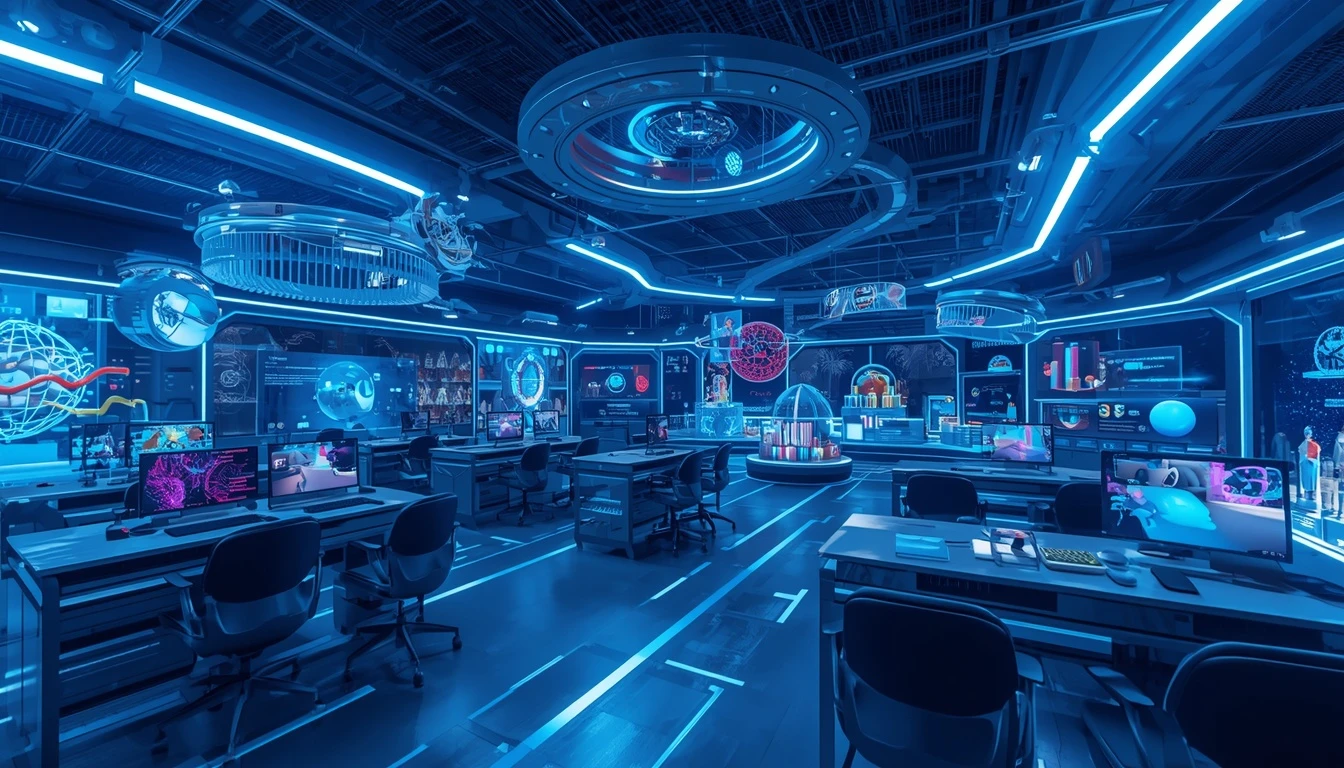
Virtual reality and artificial intelligence can also change the structure of organizational activities and work communications. In virtual work environments, team members can gather in a three-dimensional space without being physically present in one location, review projects, and interact with digital tools.
Artificial intelligence can perform tasks such as managing meeting information, real-time translation of conversations, preparing discussion summaries, and analyzing project data in these environments. Intelligent assistants can also help team members access documents, answer questions, and perform daily tasks.
This transformation has a close connection with the article The Future of Remote Work: The End of Physical Offices? While traditional remote work relies more on video communication and online collaboration tools, virtual reality environments can add a sense of shared presence and spatial interaction to work meetings.
On the other hand, artificial intelligence can transform these environments into spaces in which some organizational processes are managed automatically. Such a combination can increase team productivity and reduce geographical limitations in professional collaborations.
The Role of Intelligent Agents and AGI in Virtual Experiences
The new generation of artificial intelligence is not limited to responding to user commands. Intelligent agents (AI Agents) can plan a set of tasks, collect the required information, and perform different actions based on defined goals.
In virtual reality environments, these agents can become intelligent digital characters that have the ability to interact naturally with users. For example, a virtual guide can manage the user's movement path, answer their questions, and provide new suggestions based on environmental conditions.
At a more advanced level, the development of Artificial General Intelligence (AGI) can create broader perspectives for this technology. If systems with more general abilities in learning and problem-solving are achieved, virtual environments can go beyond predefined scenarios and create more complex interactions.
This topic is related to the article AGI-Powered Intelligent Agents: The Future of Automation and Autonomous Decision-Making. Just as intelligent agents can play a role in performing tasks and making decisions in this field, they can also create experiences in the virtual world that do not depend only on direct user commands.
However, it should be noted that AGI is still a research goal, and today's artificial intelligence systems should not be considered equivalent to artificial general intelligence. Nevertheless, the progress of intelligent agents and multimodal models can pave the way for developing more advanced virtual experiences.

Applications of Artificial Intelligence and Virtual Reality in Different Industries
The combination of virtual reality and artificial intelligence can be used in different industries beyond entertainment and education. By creating simulated environments and intelligently analyzing data, this technology makes it possible to test, train, and make decisions under controlled conditions.
In healthcare, doctors can use virtual reality environments to practice surgery and examine complex treatment conditions. Artificial intelligence can also help analyze information and provide feedback on simulation processes.
In industry and manufacturing, virtual environments make it possible to design and test production lines, examine equipment performance, and train employees. Artificial intelligence can also analyze simulation data and identify potential problems before they occur in the real environment.
In architecture and real estate, users can enter a virtual version of a building before it is constructed and examine its different sections. Intelligent systems can also provide suggested design changes based on users' needs.
In tourism, virtual visits to historical and natural locations can also be combined with intelligent guides so that users receive more accurate information about the environment.
These applications show that the main value of this technological combination is not only creating three-dimensional images; rather, it is providing a platform for intelligent interaction, analysis, and decision-making in simulated environments.
Challenges and Limitations of Developing Intelligent Experiences
Despite its extensive potential, combining virtual reality and artificial intelligence also comes with challenges. One of the most important limitations is the cost of equipment and infrastructure required to create advanced virtual reality environments. High-quality headsets, powerful processors, and artificial intelligence processing systems can increase the cost of developing and using this technology.
Privacy and information security are also very important. Virtual reality systems may collect information about body movements, user behavior, sounds, and interaction patterns. Combining this data with artificial intelligence algorithms requires precise policies for managing, storing, and protecting information.
Other challenges include delays in information processing, low quality of intelligent interactions, hardware limitations, and the possibility of artificial intelligence systems providing incorrect responses. In addition, designing environments that are accessible and simple for different users requires continuous research and development in the field of user experience.
To expand this technology, developers must pay attention to security, scalability, user experience quality, and compatibility between different systems in addition to technical capabilities. Pishgaman Lotus, in the process of developing intelligent software solutions, also considers attention to these infrastructures an important part of creating reliable digital products.
Conclusion
Moving Toward a New Generation of Intelligent Experiences
The combination of virtual reality and artificial intelligence can reduce the boundaries between digital environments and real experiences more than before. Virtual reality provides a platform for presence and interaction in three-dimensional spaces, while artificial intelligence transforms these spaces into dynamic and intelligent environments through data analysis, learning, and decision-making.
From personalized education and virtual work environments to industrial, medical, and tourism simulations, these two technologies can change the way humans interact with information and digital services.
In the future, the progress of intelligent agents, multimodal models, and virtual reality technologies can create the foundation for experiences in which the digital environment not only responds to users' presence but also has the ability to understand conditions and provide appropriate responses.
Pishgaman Lotus, by focusing on the development of advanced software and artificial intelligence-based solutions, considers this convergence an opportunity to create a new generation of digital products and services; a generation in which intelligent interaction, personalization, and user experience will play a central role.
Our articles:"The Future of Remote Work: The End of Physical Offices?"
Blog Tags
Similar Blogs
Virtual Reality and Augmented Reality; Differences and Applications

Metaverse and Virtual Reality: The Future of the Digital World
Virtual Reality Applications in Education and Learning
Have special project to begin?
Contact us if you need a unique website for your special requirements, if you think having a mobile application help you reach your business’s goals or you still do not recognize which product can help you implement your ideas. Lotus Pioneers accompany you to develop your business through consulting and by designing special products.