Holography and AGI: Intelligent Interaction in a Three-Dimensional World
Holography and AGI

Introduction
When Artificial Intelligence Enters the Three-Dimensional World
Imagine interacting with an artificial intelligence assistant represented as a three-dimensional hologram, moving virtual objects through a physical space, or exploring complex concepts through interactive models floating in front of you. Combining holographic technology with Artificial General Intelligence (AGI) could pave the way for such experiences, gradually blurring the boundaries between digital interaction and the physical world.
Holography enables the recording and reconstruction of three-dimensional visual information, while AGI refers to a hypothetical form of artificial intelligence capable of learning, reasoning, and solving a broad range of problems across different domains. If the anticipated capabilities of AGI become a reality, combining these technologies could transform how people interact with information, intelligent assistants, and digital environments.
This article explores how holography and AGI could work together, which applications they might enable, and what challenges must be addressed to turn these ideas into practical solutions.
What Are Holography and AGI?
Holography: Presenting Information in Three Dimensions
Holography is a technology for recording and reconstructing optical information to produce three-dimensional representations of objects. Unlike conventional two-dimensional displays, advanced holographic systems can present visual information in ways that enhance the perception of depth and spatial relationships. However, not every product marketed as a hologram uses true holographic technology. Some rely on volumetric displays, reflection-based techniques, or augmented reality.
The value of this technology extends beyond visual appeal. Three-dimensional representations can make complex structures easier to understand, improve the examination of engineering models, and support interaction with spatial data. For example, instead of viewing an industrial model on a conventional screen, users could examine its components from different angles and better understand how its parts relate to one another.
AGI: Intelligence Beyond a Single Task
Artificial General Intelligence, or AGI, refers to a hypothetical system capable of learning a broad range of cognitive tasks and applying that knowledge across different situations. This concept differs from many existing AI systems, which, despite their expanding capabilities, may still depend on specialized data, tools, or configurations for particular tasks.
For a deeper exploration of this concept, the Pishgaman Lotus blog article Artificial General Intelligence: Can AGI Achieve Human-Level Understanding? examines fundamental questions about AGI's potential capabilities and how they differ from human intelligence.
The combination of holography and AGI becomes particularly interesting when an intelligent system can do more than answer questions. It could potentially analyze a three-dimensional environment, interpret user needs, and adapt the presentation of information accordingly. Achieving this level of functionality, however, would depend on advances in spatial understanding, multimodal interaction, and intelligent reasoning.
How Could Holography Transform Interaction with AGI?
From Text-Based Assistants to Three-Dimensional Assistants
Most current interactions with AI take place through text, voice, or two-dimensional graphical interfaces. In an advanced holographic environment, an intelligent assistant could present information as three-dimensional models, allowing users to interact directly with a subject instead of relying entirely on lengthy explanations.
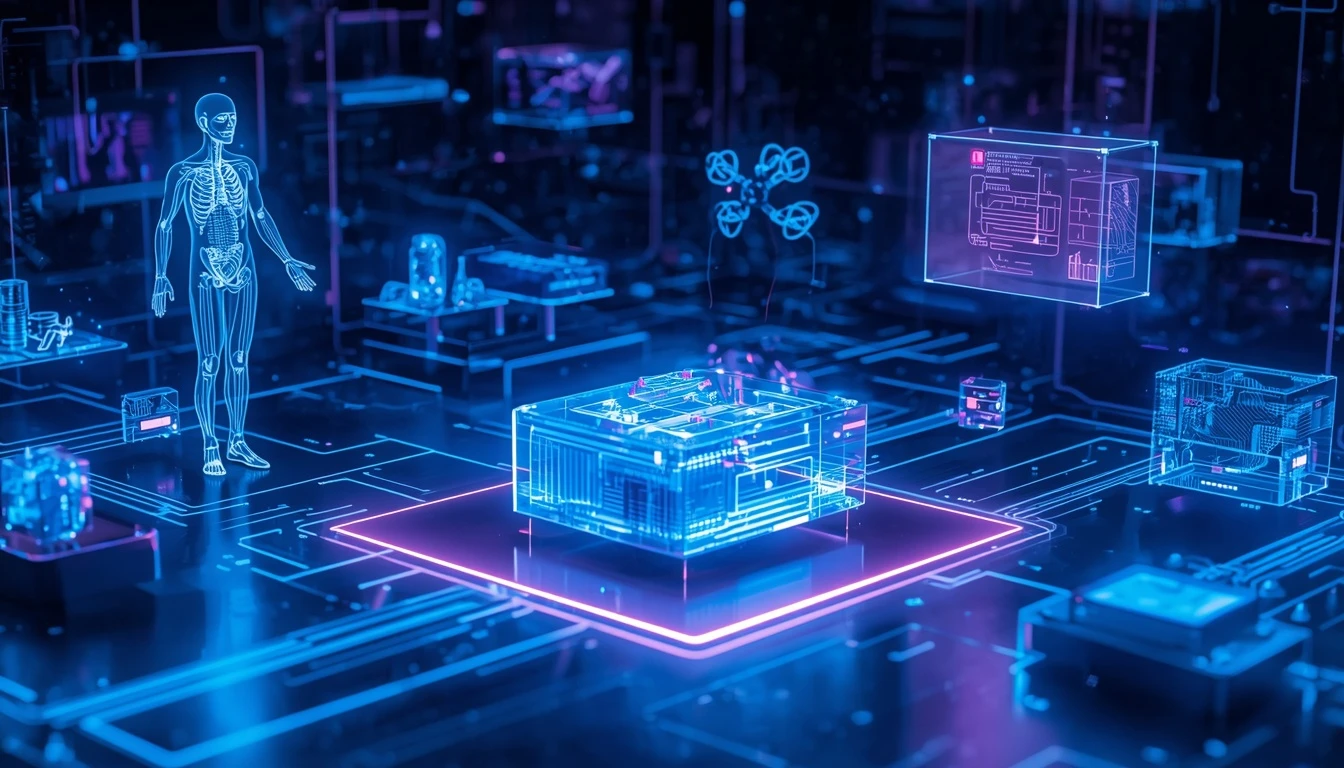
For example, an educational assistant could display the internal structure of an engine in three dimensions. When a user asks about a particular component, the assistant could provide relevant information, highlight the component, or show it from another perspective. In this scenario, the AI system interprets the request and generates a response, while the three-dimensional display presents the information in a more accessible format.
Natural Interaction Through Gestures and Environmental Awareness
Combining AGI with holography could complement technologies such as speech recognition, computer vision, hand tracking, and spatial understanding. Users might interact with three-dimensional content by speaking, pointing, or moving their hands.
For instance, a product designer could ask an intelligent assistant to modify a component's dimensions, compare two designs, or suggest a version that meets specific manufacturing constraints. The system could analyze the request, modify the model, and display the result within the same interactive environment.
However, natural interaction requires more than simply displaying a hologram. Accurate gesture recognition, correct interpretation of user intent, fast response times, and effective coordination between software and hardware all contribute to the overall experience.
Personalizing Three-Dimensional Environments
Another potential capability is adapting a three-dimensional environment to the user's goals, knowledge level, and preferences. An educational environment, for example, could display simplified models for beginners while providing advanced technical details and data for experienced professionals.
If an intelligent system can accurately interpret conversational context and user requirements, it could deliver a more personalized experience. This approach could be useful in education, design, simulation, and technical support.
Applications of Holography and AGI Across Industries
Interactive Education and Learning
In education, combining three-dimensional environments with intelligent systems could make complex concepts easier to visualize and understand. Students could explore molecular structures, human anatomy, physical phenomena, and engineering models in three dimensions while asking questions about different components.
An advanced intelligent assistant could adapt its explanations to the user's questions, provide relevant examples, and visually demonstrate the stages of a process. Such an approach could improve conceptual understanding, although its effectiveness would depend on instructional design, information accuracy, and learners' individual needs.
Healthcare and Medical Simulation
In healthcare, three-dimensional anatomical models can support medical education, the examination of medical images, and the planning of certain clinical procedures. An intelligent system capable of analyzing medical images and data could potentially provide relevant information alongside a three-dimensional model for clinicians to review.
For example, an interactive environment could display a three-dimensional anatomical structure, allowing a physician to examine different regions. However, clinical applications require scientific validation, privacy protection, and professional oversight. A holographic display alone does not guarantee accurate diagnosis or reliable medical decision-making.
Industry, Engineering, and Equipment Maintenance
In industrial environments, three-dimensional equipment models combined with intelligent assistants could support employee training, component identification, and maintenance procedures. A technician examining a machine, for instance, could view its three-dimensional model and request relevant instructions for a particular component.
More advanced systems could eventually analyze sensor data and maintenance records to identify potential problems and present suggested solutions within a three-dimensional environment. This could reduce the time spent searching for information and help standardize maintenance procedures.
E-Commerce and Product Design
Holography could extend product exploration beyond static images. Users might be able to examine three-dimensional product models, inspect their dimensions, and compare different versions.
When combined with an intelligent assistant, this experience could become more interactive. A customer could ask questions about a product's materials, dimensions, or features, while the system presents relevant information alongside the three-dimensional model. Implementing such experiences would require suitable display technologies, accurate product data, and an effective user interface.
The Role of Intelligent Agents in Managing Holographic Environments
From Answering Questions to Executing Tasks
Conventional intelligent assistants are often used to answer questions or generate content. Intelligent agents, however, can receive a goal, plan a series of actions, and execute them using available tools. In a holographic environment, these agents could potentially search for information, generate three-dimensional models, modify their components, and coordinate multiple software tools.
For example, a user could ask a design assistant to prepare a product prototype. The agent could gather the necessary information, generate an initial model, and make it available for examination in a three-dimensional environment. It could then incorporate the user's feedback and make the requested modifications.
Such workflows do not necessarily require AGI. Many narrower capabilities can already be implemented using specialized AI agents. The hypothetical distinction is that AGI could adapt to a much broader range of tasks and unfamiliar situations without requiring a separate, task-specific design for every application.
Connecting Intelligent Agents with the Future of Automation
Intelligent agents operating in three-dimensional environments could automate parts of design, training, analysis, and operational management. The Pishgaman Lotus article AGI-Based Intelligent Agents: The Future of Automation and Independent Decision-Making explores how intelligent agents may execute tasks and support decision-making.
In advanced scenarios, an agent could analyze data, compare several possible solutions, and present the results as an interactive three-dimensional model. This could be particularly valuable in environments where decisions depend on spatial information.
However, delegating sensitive tasks to autonomous systems should involve access restrictions, action logging, review mechanisms, and human approval where appropriate. As a system's autonomy increases, monitoring and evaluating its performance become increasingly important.
Technical Challenges and Limitations of AGI-Driven Holography
Hardware and Three-Dimensional Display Limitations
High-quality holographic experiences require suitable display technologies, powerful graphics processing, and, in some cases, specialized equipment. Image resolution, viewing angles, ambient lighting, physical display limitations, and equipment costs all influence the technology's potential for widespread adoption.
Generating and updating complex three-dimensional models in real time can also demand substantial computing resources. Delivering a smooth experience requires balancing visual quality, processing speed, and available hardware capabilities.
Spatial Understanding and AI Errors
To interact effectively with a three-dimensional environment, an intelligent assistant must correctly interpret object positions, spatial relationships, environmental constraints, and user intent. Misjudging the distance, dimensions, or position of a component could have serious consequences in engineering and industrial applications.
Current AI models can sometimes produce inaccurate information or misunderstand spatial relationships. System outputs must therefore be evaluated according to the risk level of the application. In sensitive situations, expert review and reliable data sources are essential.
Security, Privacy, and User Trust
Intelligent holographic environments may rely on cameras, motion sensors, microphones, and behavioral data. Combining these sources can improve the user experience, but it also raises important privacy and security concerns.
To reduce these risks, systems should collect only the information necessary for their intended purpose, enforce appropriate access controls, and protect sensitive information. Users should also understand what data is being collected and how the system uses it to generate recommendations or make decisions.
Development Costs and Infrastructure
Building these solutions may require specialists in artificial intelligence, image processing, three-dimensional design, software development, and user experience design. Integrating these components can also be challenging without a suitable software architecture, systematic testing, and continuous evaluation.
Pishgaman Lotus can support the development of interactive intelligent solutions through its AI, software development, and UI/UX design services, helping businesses explore feasibility, build prototypes, and develop products tailored to their requirements.

The Future of Human-AI Interaction in Three Dimensions
From Two-Dimensional Interfaces to Intelligent Spatial Environments
Digital interfaces are gradually expanding beyond static screens toward experiences in which information, objects, and tools can be explored in three-dimensional space. Combining this approach with AI could enable environments that do more than display information: they could organize and interpret it according to the user's needs.
For a broader introduction to the evolution of three-dimensional displays, the Pishgaman Lotus article Innovative Holography Ideas and 3D Displays explores emerging display technologies and their potential applications.
In such a future, users might work within a single interactive environment rather than switching between multiple windows and software applications. This environment could present relevant information as models, charts, or three-dimensional simulations. Realizing this vision, however, would require coordinated advances in hardware, software, AI, and interaction standards.
Implications for Jobs and Future Skills
Combining AI with three-dimensional interfaces could reduce certain repetitive tasks while creating new opportunities in interactive design, virtual environment development, software engineering, and three-dimensional content production. At the same time, some occupational roles may change as workflows and market requirements evolve.
The Pishgaman Lotus article The Impact of AGI on the Job Market: A Major Threat or a Golden Opportunity? examines these changes from the perspective of employment and potential new opportunities. In holography, as in other emerging technologies, the outcome will depend on how the technology is adopted, how quickly it develops, and how effectively workers acquire new skills.
Spatial user experience design, human-AI interaction, three-dimensional modeling, and intelligent system evaluation may become increasingly valuable. Alongside technical expertise, critical thinking, creativity, and the ability to evaluate AI-generated outputs will remain essential.
Will Holographic Interaction with AGI Become Reality?
Elements of this vision already exist in the form of three-dimensional displays, augmented reality, virtual reality, and intelligent assistants. However, achieving genuine AGI capable of adapting and reasoning across a broad range of situations remains an unrealized goal.
The future of holographic AI interaction will therefore likely develop gradually. Specialized solutions for education, engineering, and design may expand first. As intelligent capabilities, hardware, and software standards improve, more sophisticated interactive experiences could become possible.
Conclusion
Connecting Artificial General Intelligence with the Three-Dimensional World
Combining holography and AGI could create a new way to interact with technology. Instead of presenting information only on a screen, this approach could make it available within an interactive three-dimensional environment. From education and healthcare to industry, engineering, and e-commerce, the combination has the potential to transform how people understand information and perform certain tasks.
However, AGI's potential capabilities should not be confused with the abilities of current AI systems. Developing these experiences will depend on advances in spatial understanding, real-time processing, user interface design, data security, and three-dimensional display technology.
For businesses, a practical approach is to start with a clearly defined problem, evaluate available technologies, develop a prototype, and measure its actual value to users. Ultimately, the success of intelligent interaction in a three-dimensional world will depend not simply on technological sophistication, but on the ability to solve real problems and deliver reliable, useful experiences.
Our articles:"Innovative Holography Ideas and 3D Displays"
Blog Tags
Similar Blogs


Have special project to begin?
Contact us if you need a unique website for your special requirements, if you think having a mobile application help you reach your business’s goals or you still do not recognize which product can help you implement your ideas. Lotus Pioneers accompany you to develop your business through consulting and by designing special products.