Facial Recognition & Deepfake: The New Biometric Security Challenge
Facial Recognition & Deepfake
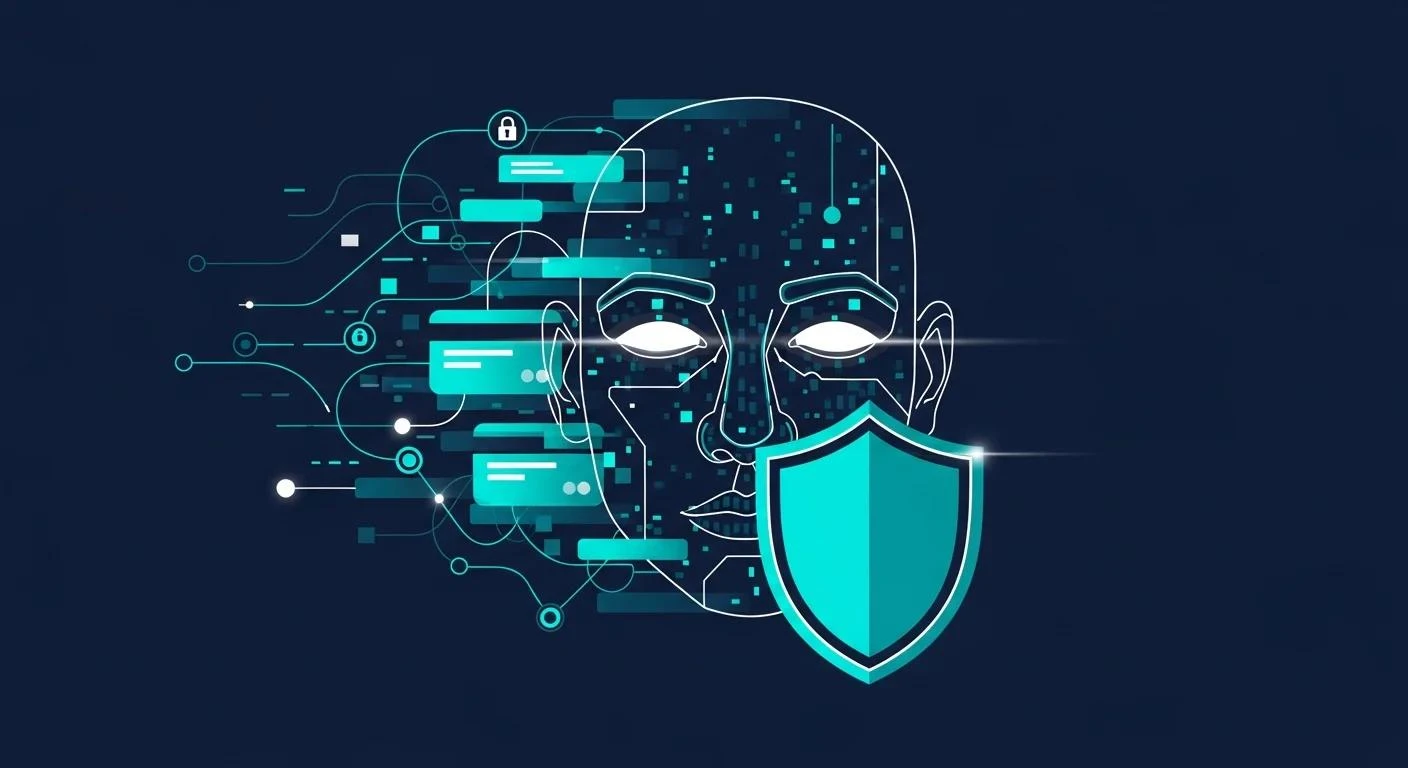
Introduction: When a Face Is No Longer Reliable Proof of Identity
For years, the human face has been one of the most important tools for identity verification. From unlocking smartphones to accessing banking applications, authenticating users on online services, and even security controls, facial recognition technology has replaced many traditional methods such as passwords.
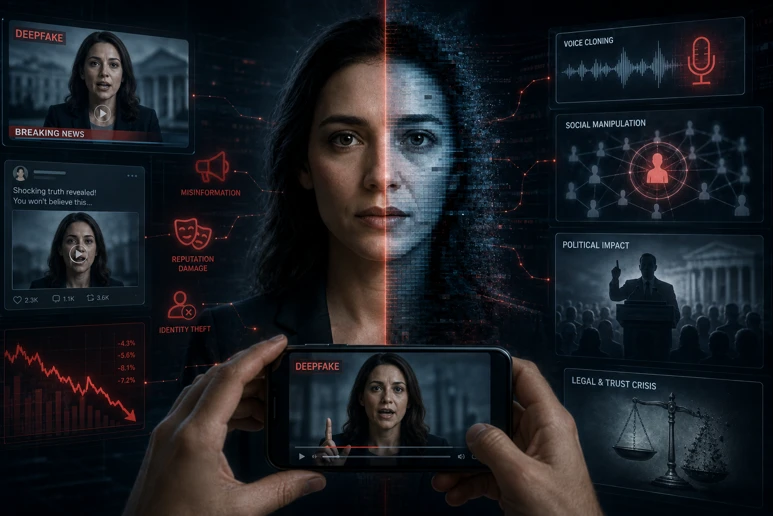
However, alongside the rapid advancement of artificial intelligence, a serious challenge has emerged for this technology: Deepfake.
Deepfake refers to technologies that use artificial intelligence models and deep learning to reconstruct or manipulate a person’s face, movements, facial expressions, and even voice in highly realistic ways. As a result, a system that relies solely on facial imagery may encounter an image that looks almost identical to the real person but has no connection to their actual physical presence.
This has shifted the competitive landscape from simply “facial recognition” toward “face authenticity detection.” Modern security systems must no longer ask only, “Whose face is this?” They must also answer, “Does this face actually belong to a real person present in front of the camera, or is it an image, video, or synthetic piece of content?”
Under these circumstances, image processing, computer vision, and artificial intelligence have become some of the most important lines of defense against identity fraud. These technologies can play a significant role in developing secure products for the future, an area of particular importance for organizations such as Pishgaman Lotus as they develop AI solutions, enterprise software, mobile applications, and digital infrastructure.
How Does Biometric Identity Verification Work?
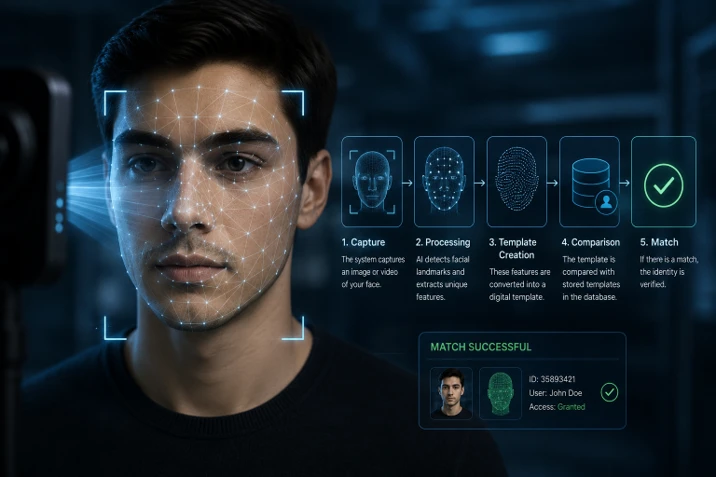
In its simplest definition, biometric identity verification is a process in which a system examines a unique human characteristic to identify or verify an individual. This characteristic can be a face, fingerprint, iris, voice pattern, or other physical and behavioral attributes.
In facial recognition systems, the camera first captures an image or video of the user. Image-processing algorithms then locate the face and extract identifiable features. A machine-learning model converts these features into a numerical representation and ultimately compares them with previously registered information.
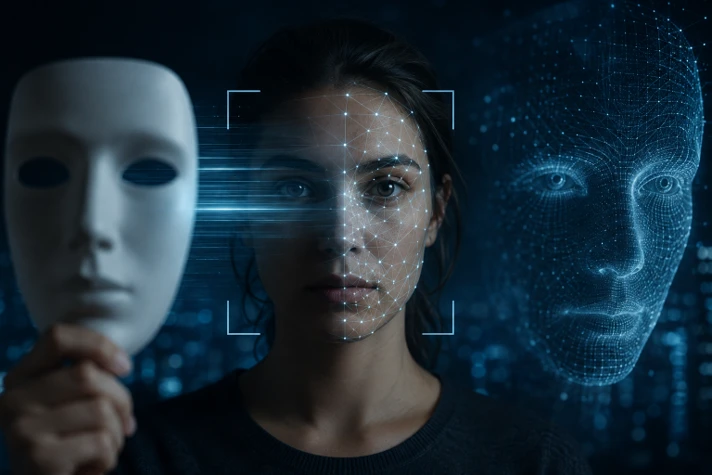
At this stage, it is important to understand that facial recognition and liveness detection are not exactly the same concept. A system may be able to match the face in an image with a registered face, while still being unable to determine whether the image belongs to a real person standing in front of the camera or is simply a photograph, display, mask, or replayed video.
Modern identity-verification standards have also recognized the importance of this issue. For example, the NIST SP 800-63B Digital Identity Guidelines require the use of Presentation Attack Detection, or PAD, for facial recognition systems.
Therefore, the future of identity verification does not depend solely on more powerful facial-recognition algorithms. It also depends on the system’s ability to determine the authenticity of the data captured by the camera.
What Exactly Is the Deepfake Threat to Identity Verification?
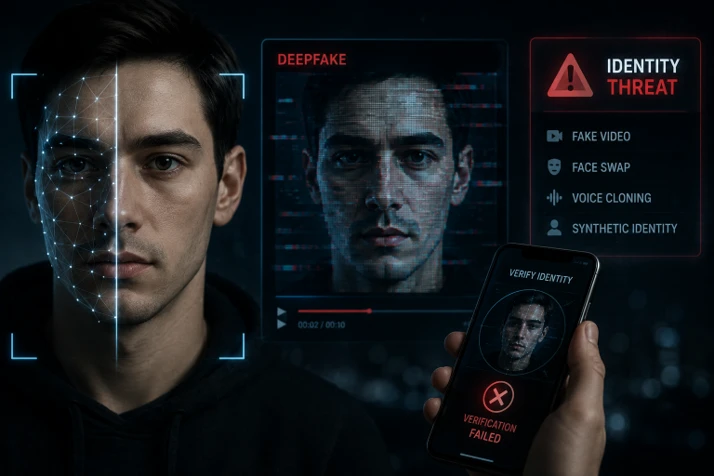
Deepfake becomes dangerous for biometric systems when synthetic content can imitate the visual characteristics of a real person with sufficient accuracy. In such cases, an attacker can create content that appears authentic to humans or even to basic facial-recognition systems.
Imagine that a financial service uses facial recognition for user login. If the system only checks whether the face in the image matches the registered face, a fake image, replayed video, or AI-generated content may be able to deceive the authentication process.
The threat is not limited to video Deepfakes. Presentation Attacks can include printed photographs, images displayed on mobile devices, replayed videos, and even three-dimensional masks. Research into Presentation Attack Detection has demonstrated for years that facial-recognition systems without anti-spoofing layers can be vulnerable to such attacks.
Another form of identity fraud that has become increasingly important is Face Morphing. In this technique, the facial characteristics of two individuals are combined into a single image. The resulting image may be designed in such a way that a facial-recognition system associates it with both individuals. In 2025, NIST also published approaches and guidelines for detecting such morphed images.
Therefore, the core issue is no longer simply whether an image is “fake.” The attacker is attempting to construct a synthetic identity that appears legitimate throughout the entire authentication process.
Why Is Deepfake Detection Difficult for Image Processing Systems?
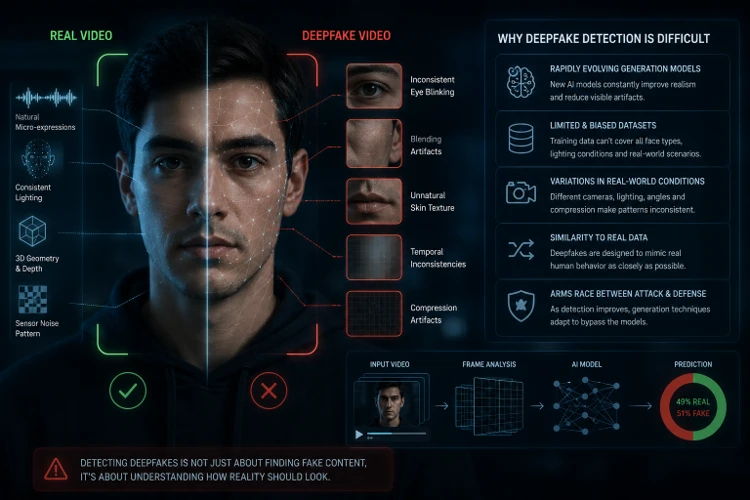
One of the main reasons this problem is so complex is the rapid advancement of image- and video-generation models. New generations of AI models can reproduce facial details, lighting, lip movements, and even subtle facial expressions with remarkable realism.
In the past, a fake video could often be detected relatively easily because of obvious errors around the eyes, mouth, or facial boundaries. However, as generative models have improved, these simple visual indicators have become increasingly difficult to detect.
At the same time, a Deepfake detection system must operate under real-world conditions. It needs to deal with poor lighting, different cameras, varying video quality, image compression, head movement, and changes in facial angles. A model that performs well in a laboratory environment does not necessarily maintain the same level of accuracy in the real world.
For this reason, Deepfake detection is not a static problem. Attackers and defense systems are constantly competing with one another. Whenever a detection algorithm learns a new indicator of manipulation, content-generation technologies can evolve to remove or conceal that indicator.
The Role of Image Processing in Combating Fake Videos
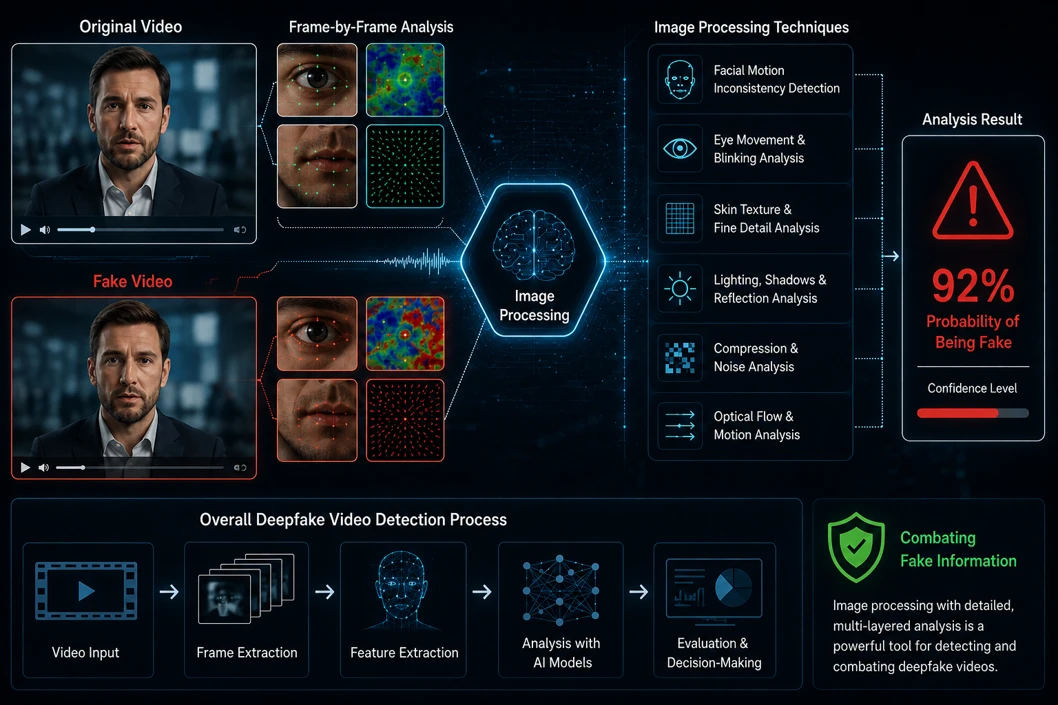
Image processing is one of the first layers that can be used to examine the authenticity of visual content. A system can analyze details related to skin texture, lighting, shadows, facial boundaries, compression patterns, and other visual characteristics.
In a real video, changes between frames generally follow the physical and natural patterns of human movement. Synthetic content, however, may contain extremely subtle inconsistencies in certain areas. For example, unnatural changes in skin texture, inconsistent lighting across different parts of the face, or tiny differences between consecutive frames can serve as signals for a specialized model.
However, no single indicator can guarantee that a video is real or fake. For this reason, advanced systems typically analyze multiple features simultaneously.
This is where technologies such as deep neural networks, computer-vision models, and temporal video analysis become important. Instead of examining only a single image, a model can analyze a sequence of frames and evaluate facial behavior over time.
For an organization such as Pishgaman Lotus, which operates in artificial intelligence, complex software development, and digital solutions, these technologies can provide a foundation for designing intelligent identity-verification systems, anti-fraud platforms, and next-generation security services.
Liveness Detection: Determining Whether a Real Person Is in Front of the Camera
One of the most important defensive technologies against biometric attacks is Liveness Detection.
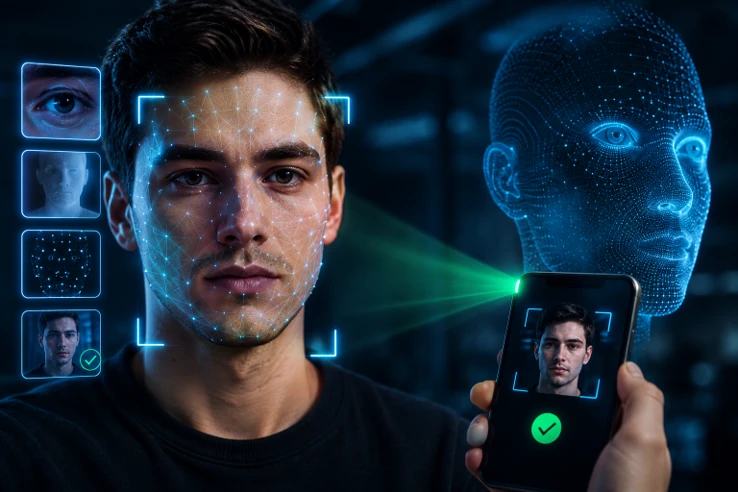
The basic idea seems simple: the system must determine whether the camera is interacting with a real human being rather than an image or replayed content.
In practice, however, this is much more complicated. If the system only asks the user to blink, move their head, or smile, a suitable video may also be able to reproduce the same behavior. Therefore, modern Liveness Detection systems need to go beyond simple movement-based instructions.
More advanced systems examine information such as depth, natural facial movement, lighting changes, skin texture, and other physical characteristics. Using multiple channels, such as RGB imagery, depth, near-infrared, and thermal information, can also improve detection capabilities. Research in the field of PAD has shown that combining multiple types of data can be useful for defending against sophisticated attacks.
As a result, Liveness Detection should not be considered merely an optional feature of an authentication system. It is becoming one of the core components of biometric security.
From Facial Recognition to Multilayer Identity Analysis
One of the most important changes in the future of authentication is that systems will no longer rely on a single signal.
If a system only analyzes the face, an attacker can attempt to manipulate the face. If the system only analyzes video, the attacker can generate synthetic content. If it only examines head movement, the attacker may attempt to reproduce similar movements in a fake video.
The logical solution is to combine multiple security layers.
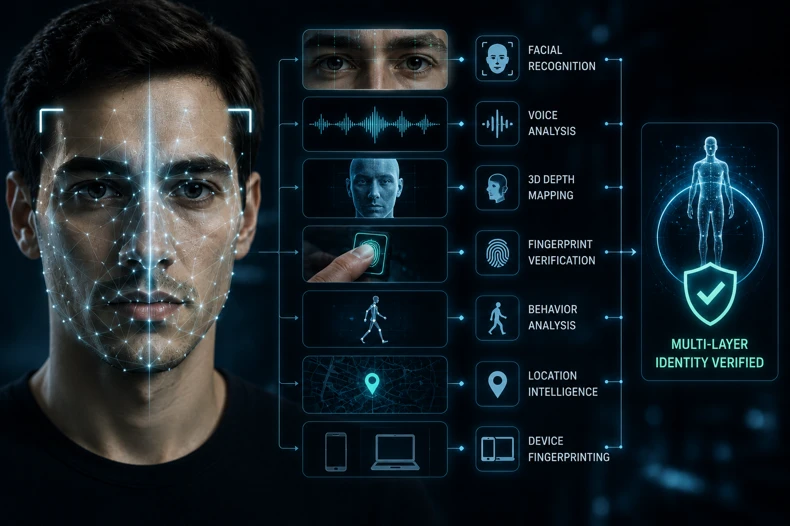
In an advanced architecture, the system can simultaneously examine facial characteristics, liveness, behavioral patterns, device information, user interaction patterns, and other trusted signals. Each layer may not be completely flawless on its own, but combining them can reduce the likelihood of a successful attack.
This approach can be considered a form of Multi-Layer Biometric Verification, in which a user’s identity is verified not through a single image, but through a collection of pieces of evidence.
Such an architecture is particularly important for banking applications, digital wallets, enterprise systems, government services, financial platforms, and even mobile applications.
Deepfake Is Not Just an Image Problem
One common misconception is to treat Deepfake as merely an image-related problem. In reality, identity fraud can simultaneously target a user’s image, voice, documents, and digital behavior.
Imagine an attacker generating an artificial face while also creating a voice that resembles the real person. If the system examines only the image and voice separately, both signals may appear legitimate. However, if the temporal and semantic relationship between the voice and lip movements, facial behavior, and other indicators is analyzed, the likelihood of detecting synthetic content increases.
For this reason, the future of biometric security is moving toward Multimodal AI. Multimodal artificial intelligence can analyze visual, audio, and behavioral data together.
This transformation means that image processing will no longer be an isolated technology. Instead, it will become part of a larger ecosystem for analyzing digital identity.
Technical and Security Challenges Facing Anti-Deepfake Systems
One of the biggest challenges is the speed at which synthetic-content-generation technologies evolve. A detection model may perform extremely well on the dataset it was trained on, but its performance may decline when it encounters a new type of Deepfake.
Another issue is the diversity of hardware and environmental conditions. A smartphone camera, laptop webcam, and security camera have different qualities and characteristics. Environmental lighting, facial angle, internet speed, and video compression can also eliminate important information.
At the same time, the system must balance security and user experience. If the authentication process is excessively strict, legitimate users may be rejected repeatedly. If the system is too simple, the likelihood of an attacker bypassing it increases.
Therefore, the success of an anti-Deepfake system cannot be measured solely by its “fake detection rate.” The false acceptance rate for fraudulent users, the false rejection rate for legitimate users, processing speed, on-device capabilities, and resistance to new attacks must also be considered.
NIST has also emphasized the evaluation of Presentation Attack Detection algorithms, demonstrating the importance of standardized and comparable evaluation for accurately assessing this technology.
What Will the Future of Biometric Identity Verification Look Like?
The future of authentication will likely move toward systems in which users do not constantly need to prove “who they are.” Instead, the system will continuously evaluate whether their behavior and digital characteristics remain consistent with their registered identity.
In such an environment, the camera will not simply capture an image of the face. The system can analyze depth, movement, facial characteristics, behavior, the device being used, and other security signals simultaneously.
At the same time, on-device processing is likely to become increasingly important. Local analysis of biometric information can, in some architectures, reduce the need to transmit raw data to servers. This can help reduce latency while also improving privacy.
We can also expect security standards, evaluation methods, and synthetic-content detection technologies to evolve more rapidly. In recent years, NIST has focused on areas such as Presentation Attack Detection and Face Morphing, demonstrating that combating biometric fraud has become a serious field within digital security.
In this future, technology companies capable of combining image processing, artificial intelligence, software security, and user experience will have an important advantage. Pishgaman Lotus, with its focus on AI solutions, mobile software, enterprise software, and digital infrastructure, can also play a role in designing this new generation of intelligent products.
Conclusion: The Real Battle Is a Battle for Trust
Deepfake has demonstrated that in the digital world, seeing a face does not necessarily mean seeing a real human being. The image captured by a camera may result from the actual presence of an individual or from a complex combination of artificial-intelligence algorithms.
For this reason, the next generation of biometric systems must move beyond simple “facial recognition” toward authenticity detection, liveness detection, and multilayer identity analysis.
Image processing, computer vision, deep learning, video analysis, and multimodal artificial intelligence will play fundamental roles in this transformation. The most successful systems will probably not simply be those with a more powerful model. Instead, they will be systems that combine multiple security layers within a coordinated architecture.
The future battle between artificial intelligence and Deepfake is not truly a battle between two sides of technology; it is a battle over digital trust. As synthetic content becomes increasingly realistic, the ability to detect authenticity must become smarter, faster, and more multilayered.
For businesses, banks, applications, and organizations where user identity is a critical part of security, investing in anti-spoofing technologies will no longer be a luxury feature. It will become part of the digital security infrastructure.
In this context, combining artificial intelligence, image processing, and secure software development can provide the foundation for building the next generation of identity-verification services—an area that offers significant opportunities for innovative and secure solutions at organizations such as Pishgaman Lotus.

Our articles:"Image Processing on Edge Devices: When AI Fits in Your Pocket!"
Similar Blogs

Cancer Detection with Image Processing and Artificial Intelligence


Image Processing and Object Detection in Autonomous Vehicles

Text-to-Video: The AI Revolution in Video Creation
Have special project to begin?
Contact us if you need a unique website for your special requirements, if you think having a mobile application help you reach your business’s goals or you still do not recognize which product can help you implement your ideas. Lotus Pioneers accompany you to develop your business through consulting and by designing special products.