Holographic Technology: From Light Illusion to Virtual Reality
Holographic Technology

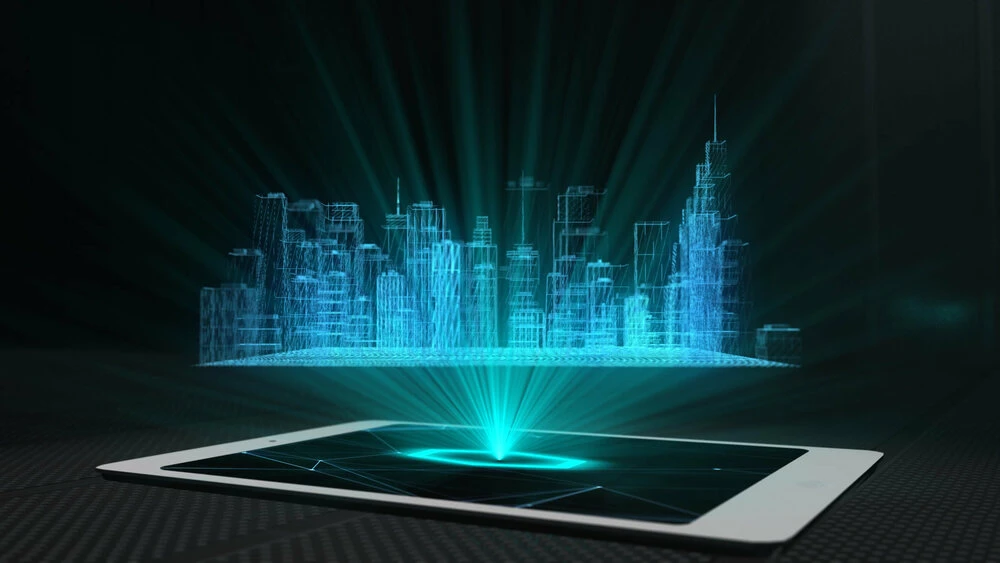
Holographic Technology: From the Illusion of Light to Virtual Reality
Part One: What Is Holography? — A Fundamental Understanding
Introduction: The Art of Recording and Reconstructing Light
Holography is an advanced technology that makes it possible to record and reconstruct three-dimensional objects using light. Unlike ordinary images, which capture only two-dimensional information (length and width), holography accurately records and displays depth as well as the third dimension. This technology allows you to view a three-dimensional object from different angles, as if it were actually standing in front of you.
In the world of display technologies, leading companies have played a key role in advancing holography. Pishgaman Lotus has invested in photonics research and advanced displays, positioning itself as one of the pioneers in this field and carrying out numerous projects involving holographic technologies.
Holography Explained Simply: A Three-Dimensional Shadow of Light
A simple analogy:
Imagine that you want to capture the shadow of an object on a wall. In ordinary photography, you can see only its overall shape. With holography, however, it is as if you create a shadow that looks exactly like the real object when viewed from different angles, allowing you to see even its back.
A Brief History of Holography
1947: The Birth of an Idea
Hungarian-British physicist Dennis Gabor introduced the concept of holography.
Original goal: To improve the resolution of electron microscopes.
He received the 1971 Nobel Prize in Physics for this discovery.
The 1960s: The Laser Revolution
The invention of the laser made practical holography possible.
The first high-quality holograms were produced.
Early applications emerged in art and security.
The 1970s–1980s: Commercialization
Holography began to be used on credit cards and security documents.
It entered the entertainment and advertising industries.
Digital holography continued to develop.
The 1990s to the Present: The Digital Era
Computer-generated holography.
Holographic displays.
Medical and industrial applications.
Basic Physical Principles
What Is Light?
Light behaves as both a wave and a particle. To understand holography, we consider light as a wave with two important properties:
1. Amplitude: The intensity or brightness of light.
2. Phase: The position of a wave within its cycle.
The Secret of Holography: Recording Both Amplitude and Phase
Ordinary photography records only the amplitude of light. Holography, however, captures both amplitude and phase, creating the perception of three-dimensional depth.
How to Create a Simple Hologram
Required Equipment:
- A laser, usually a helium-neon laser.
- Special holographic film.
- Mirrors and lenses to split the laser beam.
- An object to be recorded.
- An anti-vibration table (essential!).
Steps:
- Split the laser beam into two parts.
- Direct one beam straight onto the film (the reference beam).
- Direct the other beam toward the object and allow its reflection to reach the film.
- The two beams interfere with each other on the film.
- Once the film is developed, it becomes a hologram.
Pishgaman Lotus organizes hands-on hologram-making workshops for students in its educational laboratories, helping them gain a practical understanding of these concepts.
Part Two: Types of Holography and Their Applications
Classification of Holography
By Recording Method:
Analog Holography:
Uses photographic film.
Requires a chemical development process.
Offers high image quality but is time-consuming.
Digital Holography:
Uses digital sensors, such as CCD sensors.
Relies on computer processing.
Allows editing and manipulation.
Computer-Generated Holography:
Created entirely using software.
Does not require a physical object.
Can generate imaginary objects and scenes.
By Display Method:
Transmission Holography:
Requires light from behind the hologram for viewing.
Similar to stained-glass windows in churches.
Offers excellent image quality.
Reflection Holography:
Light illuminates the hologram from the viewer's side.
Similar to the holograms found on credit cards.
Can be viewed under ordinary lighting conditions.
Holographic Display Technologies
Volumetric Holographic Displays:
Create images within a volume of space.
Use rotating screens or mist-based systems.
Allow viewers to walk around the image and see it from all directions.
Projection-Based Holographic Displays:
Use specialized projectors with holographic lenses.
Create three-dimensional images that appear to float in the air.
Suitable for advertising and exhibitions.
Screen-Based Holographic Displays:
Similar to televisions but capable of presenting depth more realistically.
Use parallax techniques.
Are being developed for home use.
HoloLens and Smart Glasses:
Combine augmented reality with holographic visuals.
Display information within the user's field of view.
Have applications in medicine, education, and industry.
Practical Applications of Holography
Security and Identification:
Credit cards and passports.
Banknotes and important documents.
Product authenticity labels.
Pishgaman Lotus has developed a holographic security system for government documents that makes counterfeiting virtually impossible.
Medicine and Healthcare:
Three-dimensional imaging of organs.
Surgical assistance through visualizations of a patient's anatomy.
Anatomy education using holographic models.
Successful Example:
Displaying a three-dimensional tumor model for surgical planning.
Reducing surgery time by 30%.
Increasing surgical accuracy by up to 40%.
Education and Research:
Interactive educational models.
Simulations of scientific phenomena.
Virtual laboratories.
Art and Entertainment:
Holographic concerts featuring singers.
Digital art museums.
Three-dimensional video games.
Industry and Manufacturing:
Three-dimensional quality control.
Design and rapid prototyping.
Employee training through simulation.
Holography in Everyday Life
Shopping and Retail:
Display windows in luxury stores.
Product advertising.
Virtual shopping experiences.
Communication:
Three-dimensional video calls.
Virtual business meetings.
Communication that creates a sense of physical presence.
Smart Homes:
Holographic control panels.
Home entertainment.
Digital interior decoration.
Part Three: The Future, Challenges, and Opportunities
Current Technical Challenges
1. High Production Costs:
Advanced laser equipment.
Special light-sensitive materials.
The need for a controlled environment.
2. Display Limitations:
Limited viewing angles.
The need for suitable lighting.
Limited display sizes.
3. Technical Complexity:
The need for trained specialists.
Ongoing maintenance and calibration.
Integration with existing systems.
4. Limited Content:
The cost of producing holographic content.
The need for specialized software.
Time-consuming production processes.
Innovative Solutions
Advanced Digital Holography:
Using artificial intelligence algorithms.
Automated content generation.
Reducing dependence on expensive hardware.
New Materials:
More affordable light-sensitive polymers.
Photonic crystals.
Materials with greater sensitivity.
Affordable Displays:
Using LEDs instead of lasers.
Mass production to reduce costs.
Integration with smartphones.
Pishgaman Lotus is researching a new generation of holographic displays that use nanotechnology to significantly reduce production costs.
The Future of Holographic Technology
Predictions for the Next 10 Years:
2025–2030: Consumer Holography
Holographic televisions for home use.
Mobile phones with three-dimensional displays.
Holographic video conferences.
Key Features:
Affordable prices for the general public.
High-quality, natural-looking images.
Rich and diverse content.
2030–2035: Ubiquitous Holography
Replacing two-dimensional displays.
Integration with the Internet of Things.
Applications across all aspects of life.
Future Applications:
Interactive education in schools.
Remote medical treatment.
Virtual shopping experiences that allow customers to touch products.
2035–2040: Full Mixed Reality
The boundaries between the real and virtual worlds begin to disappear.
Natural interaction with digital environments.
The creation of parallel worlds.
Transformations Across Different Industries
Education:
Three-dimensional classrooms.
Virtual laboratories.
Holographic textbooks.
Medicine:
Surgery guided by holographic visualizations.
Smart prosthetics.
Targeted medications.
Industry:
Remote production monitoring and control.
Maintenance guided by holographic instructions.
Three-dimensional product design.
Entertainment:
Holographic cinemas.
Fully immersive games.
Virtual concerts.
Social and Cultural Impacts
Transforming Communication:
Bringing people who are far apart closer together.
Reducing the need for travel.
Promoting better understanding between cultures.
Changing Lifestyles:
A more immersive remote-working experience.
Personalized education.
Digital healthcare.
Emerging Challenges:
Addiction to virtual reality.
Privacy in three-dimensional environments.
Identity in digital spaces.
Economic and Career Opportunities
Market Growth:
The market is projected to reach $500 billion by 2030.
Millions of new jobs could be created.
Traditional industries may undergo major transformations.
Skills in Demand:
Three-dimensional content designers.
Photonics engineers.
Virtual reality specialists.
3D graphics programmers.
Pishgaman Lotus has designed a specialized training program to develop skilled professionals in the field of holography.
Responsibility and Ethics
Ethical Considerations:
Responsible use of technology.
Attention to psychological impacts.
Protection of privacy.
Digital Equity:
Fair access to technology.
Preventing the digital divide.
Education for everyone.
Environmental Sustainability:
Reducing electronic waste.
Improving energy efficiency.
Using recyclable materials.
Conclusion: A Bright, Three-Dimensional Future
Holographic technology is not merely an entertainment gimmick; it represents a fundamental transformation in how we interact with information and our surroundings. From education and medicine to industry and communication, this technology has the potential to change every aspect of our lives.
Recognizing the strategic importance of this technology, Pishgaman Lotus has invested not only in technical development but also in addressing its social, educational, and ethical dimensions. The company's experience demonstrates that a balanced, forward-looking approach can help harness the potential of holography to improve people's lives.
The challenges ahead—from technical limitations to ethical considerations—are significant. However, the history of science has shown that human creativity and perseverance can overcome even the most difficult obstacles.
Holography points toward a future in which:
Information is understood more naturally through three-dimensional representations.
Communication becomes deeper and more meaningful.
Education becomes more effective and engaging.
The boundary between the real and virtual worlds is managed intelligently.
Building this future requires the participation of everyone—from scientists and engineers to educators and policymakers. Through continued research and development in this field, Pishgaman Lotus is helping build a future in which technology is not only advanced but also human-centered and sustainable.
Similar Blogs
Have special project to begin?
Contact us if you need a unique website for your special requirements, if you think having a mobile application help you reach your business’s goals or you still do not recognize which product can help you implement your ideas. Lotus Pioneers accompany you to develop your business through consulting and by designing special products.