Financial & Cryptocurrency App Security: Building a Hack-Resistant Mobile App
Financial & Cryptocurrency App Security

Introduction: Why Financial App Security Matters
Financial and cryptocurrency applications handle some of the most sensitive types of user data, including personal information, account details, financial transactions, authentication credentials, encryption keys, and digital assets. As a result, even a relatively small security vulnerability can have serious consequences.
In banking, payment, digital wallet, and cryptocurrency exchange applications, attackers may attempt to gain unauthorized access to user accounts, manipulate transactions, steal authentication tokens, or exploit API vulnerabilities to access sensitive information.
For this reason, security should not be treated as a final development step. It should be considered from the early stages of architecture and UX design through mobile development, backend implementation, API security, and infrastructure management.
Pishgaman Lotus can integrate mobile application development, enterprise software development, AI, UI/UX design, and network and infrastructure expertise to make security an integral part of the digital product development lifecycle.
Start with a Secure Architecture
Application security begins with architecture. If communication between the mobile application, backend, database, and external services is not properly designed, adding security tools later may not be enough to address the underlying weaknesses.
A secure architecture should never assume that the mobile device is completely trusted. Users may run applications on rooted or jailbroken devices, reverse-engineer application packages, or attempt to intercept and manipulate network traffic.
Therefore, critical security decisions such as authentication, authorization, transaction validation, and permission management should also be enforced on the server side.
Pishgaman Lotus can design financial applications with separate security layers for the Mobile App, API, Backend, Database, and infrastructure, reducing the impact of potential attacks on any individual layer.
Multi-Layer Authentication
A username and password alone may not provide sufficient protection for a financial application.
Multi-factor authentication (MFA) can provide an additional security layer. Depending on the application's requirements, this can include one-time passwords, device verification, biometric authentication, or other security mechanisms.
For example, authentication can combine:
Password or PIN
One-time password (OTP)
Fingerprint authentication
Facial recognition
Trusted-device verification
Login attempt limitations
Biometric authentication should not replace server-side security controls. Instead, it should work alongside proper backend authentication and authorization mechanisms.
For financial applications, Pishgaman Lotus can design authentication flows based on the sensitivity of each operation. For example, viewing an account balance may require a lower security level than transferring funds or withdrawing digital assets.
Protecting Sensitive Data on Mobile Devices
One of the common security mistakes in financial application development is storing sensitive information in insecure locations.
Data such as authentication tokens, cryptographic keys, account information, identity data, and sensitive transaction information should not be stored as plain text in easily accessible application storage.
Modern mobile platforms provide secure storage mechanisms such as Android Keystore and Apple's Keychain, which can be used to protect sensitive credentials and cryptographic material.
Temporary sensitive data, outdated sessions, and unnecessary cached information should also be removed when they are no longer required.
Pishgaman Lotus can consider sensitive-data management from the application architecture stage and design data flows so that critical information is not unnecessarily stored on the user's device.
Encryption: From Data Transfer to Storage
Encryption is one of the fundamental components of financial application security.
Sensitive information should be protected while being transferred between the mobile application and backend services. Secure communication protocols such as HTTPS and TLS should be used for network communication. Depending on the application's threat model, additional mechanisms such as certificate pinning may also be considered.
However, encryption should not be limited to data transmission.
Sensitive information stored on devices, servers, and databases also requires appropriate protection. More importantly, encryption keys must be properly managed. Even a strong encryption algorithm can become ineffective if its keys are exposed or hardcoded inside the application.
Pishgaman Lotus can address encryption, secret management, authentication tokens, and key lifecycle management as part of the overall mobile and backend architecture.
API Security: One of the Most Important Attack Surfaces
A mobile application is usually only the visible part of a much larger financial system. Behind the application, APIs handle authentication, account information, transactions, and other critical operations.
If APIs are not properly secured, even a mobile application with a strong security layer can remain vulnerable.
Common API risks include broken authentication, broken authorization, insecure object-level access, excessive data exposure, and security misconfiguration.
Pishgaman Lotus can implement access control at the endpoint, object, and operation levels when designing APIs for financial applications.
Protecting Financial Transactions
In financial applications, successfully logging into an account is only the beginning.
Operations such as fund transfers, cryptocurrency purchases, asset sales, withdrawals, password changes, or changes to financial information should receive stronger security controls.
Depending on the application, these controls may include:
Re-authentication
Biometric verification
OTP confirmation
Transaction limits
Frequency limitations
Trusted-device verification
Risk-based authentication
Behavioral analysis
Multi-step transaction confirmation
For example, if a user normally performs small transactions but suddenly attempts to withdraw a large amount from a new device, the system could classify the transaction as suspicious and require additional verification.
This is an area where the combination of security, data analysis, and artificial intelligence can provide additional protection. The AI and software development capabilities of Pishgaman Lotus can be used to design intelligent security mechanisms for financial platforms.
Protection Against Reverse Engineering and Application Tampering
Mobile applications run on users' devices, which means developers must consider the possibility of reverse engineering.
Attackers may inspect an APK or IPA, decompile application components, analyze application logic, or attempt to bypass client-side security mechanisms.
Several techniques can make these attacks more difficult, including:
Code obfuscation
Tamper detection
Root and jailbreak detection
Application integrity checks
Minimizing sensitive logic on the client
Removing hardcoded secrets
Strong server-side validation
However, these mechanisms should complement—not replace—backend security.
The goal is to increase the difficulty of extracting application logic and exploiting the client while keeping critical security decisions on trusted server infrastructure.
Pishgaman Lotus can implement complementary security mechanisms across both the mobile client and backend services.
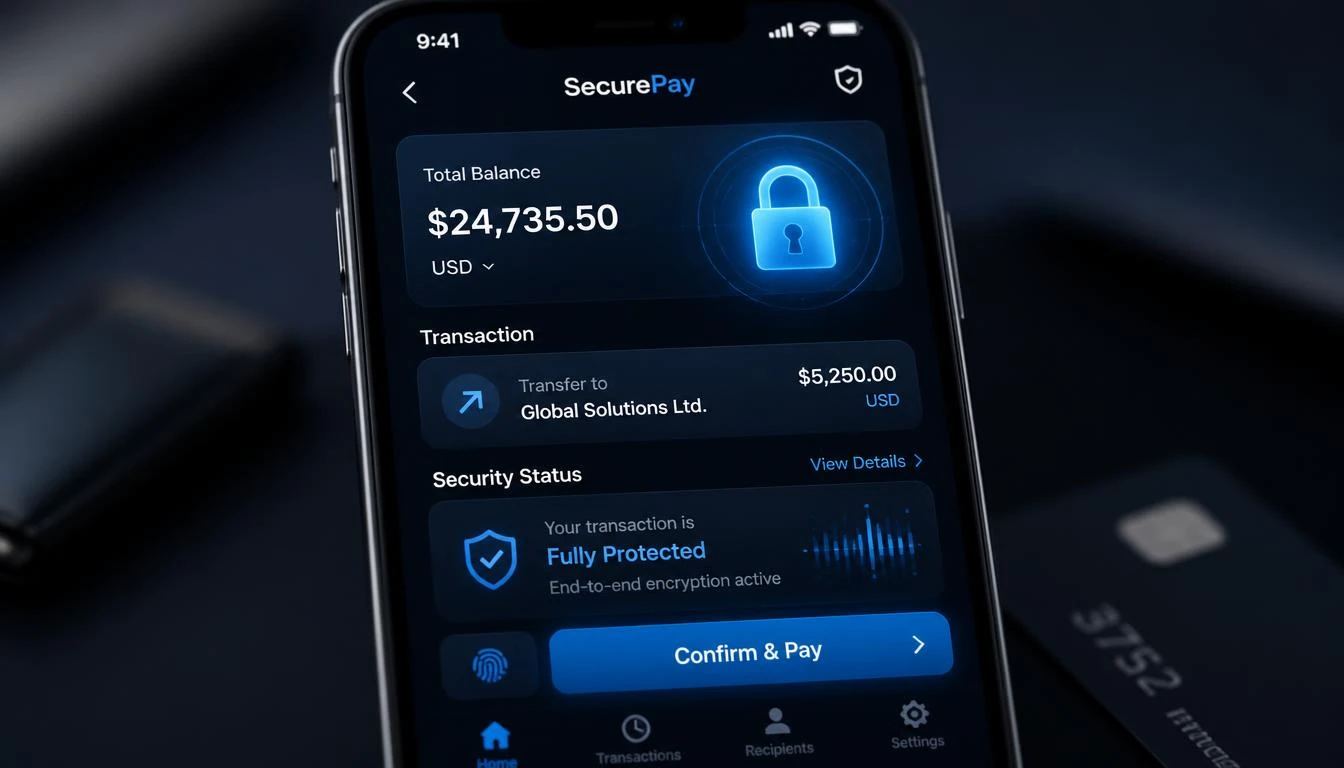
Detecting Suspicious Behavior with AI
Modern financial security is no longer limited to blocking known attack patterns.
Applications can also analyze user behavior and transaction patterns to identify unusual activity.
For example, a user may normally log in from a specific device, perform transactions within a particular range, and use the application during certain hours. A sudden change in these patterns can become a security signal.
Machine learning and AI models can be used to analyze transaction behavior, identify anomalies, detect suspicious activity, and prioritize potential security events.
AI should not necessarily make financial security decisions completely on its own. A more reliable approach is to combine AI with rule-based systems, transaction limits, risk engines, and human oversight where appropriate.
This is one of the areas where the AI and software development expertise of Pishgaman Lotus can contribute to intelligent security solutions for financial platforms.

Secure Logging and Preventing Data Leakage
Logs are essential for monitoring applications and investigating security incidents. However, they can also become a source of information leakage.
Sensitive information such as passwords, authentication tokens, private keys, complete payment-card details, and other confidential data should not be unnecessarily stored in logs.
Access to logs should also be restricted, and security events should be monitored centrally.
A professional architecture can use centralized logging, monitoring, and alerting systems to identify unusual activity and investigate incidents more quickly.
With its Network & Infrastructure capabilities, Pishgaman Lotus can also consider monitoring, infrastructure security, and centralized observability as part of the overall architecture of sensitive applications.
Penetration Testing: Test Before Attackers Do
A financial application should not be considered secure simply because its functional tests are successful.
Security testing should be performed alongside functional and performance testing.
Penetration testing can help identify weaknesses related to:
Authentication
Authorization
API security
Session management
Insecure data storage
Encryption
Reverse engineering
Request manipulation
Input validation
Information leakage
Security testing can help identify vulnerabilities before an application reaches production and reduce the potential impact of attacks.
Pishgaman Lotus can incorporate security considerations into the design, development, testing, and deployment stages of digital products rather than treating security as an isolated final step.
Security in Cryptocurrency Applications
Cryptocurrency applications introduce additional security challenges.
In some architectures, private keys or other credentials controlling digital assets are extremely sensitive. Losing or exposing a private key can potentially mean losing control over the associated assets.
Therefore, it is essential to determine where keys are generated, where they are stored, how they are used, and which components can access them.
In non-custodial wallets, the architecture should ideally ensure that the backend does not have access to the user's private keys.
In centralized platforms such as cryptocurrency exchanges, additional controls around secret management, access control, key management, auditing, and environment separation become particularly important.
Pishgaman Lotus can approach cryptocurrency application security as a combination of mobile security, backend security, API protection, infrastructure security, and secure key management.
Real Security Means Multiple Layers
Building an application that is completely impossible to penetrate is not a realistic security goal.
The objective should instead be to reduce the attack surface, prevent unauthorized access, detect suspicious behavior quickly, and limit the potential impact of successful attacks.
A strong security architecture can include multiple layers:
Layer 1: Mobile application and device security
Layer 2: Authentication and session management
Layer 3: API security and access control
Layer 4: Encryption and key management
Layer 5: Backend and database security
Layer 6: Monitoring and suspicious-behavior detection
Layer 7: Continuous security testing and assessment
With this approach, if one security layer is compromised, additional layers can help prevent the attacker from reaching critical assets.
Conclusion
Security in financial and cryptocurrency applications is not an optional feature. It is a fundamental part of the product.
From the moment a user logs in to the moment a financial transaction is completed, data, authentication, permissions, and transaction flows must be carefully protected.
Multi-factor authentication, secure storage, encryption, proper key management, API security, transaction protection, anti-tampering mechanisms, monitoring, AI-based anomaly detection, and penetration testing can work together to significantly improve application security.
Pishgaman Lotus can combine mobile application development, software development, AI, UI/UX design, and network and infrastructure expertise to make security part of the overall architecture of digital products.
This approach is particularly valuable for banking applications, payment platforms, digital wallets, cryptocurrency exchanges, financial marketplaces, and other applications that handle sensitive financial data and digital assets.
Our articles:"The Future of Cross-Platform Development: Flutter, React Native & AI"
Blog Tags

Have special project to begin?
Contact us if you need a unique website for your special requirements, if you think having a mobile application help you reach your business’s goals or you still do not recognize which product can help you implement your ideas. Lotus Pioneers accompany you to develop your business through consulting and by designing special products.