Edge AI in Mobile Apps: AI Without Internet
Edge AI in Mobile Apps
Introduction: A Future That Moves from Servers to Your Pocket
In recent years, artificial intelligence has become one of the main pillars of software development. However, until just a few years ago, almost all intelligent processing depended on servers and cloud infrastructure. This dependency not only increased response latency but also raised serious concerns about privacy and data security.
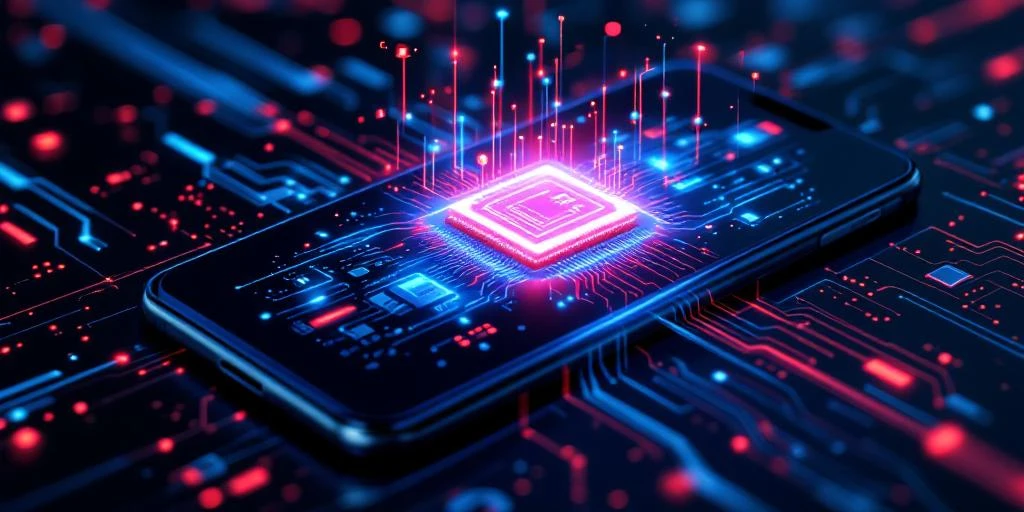
With the emergence of Edge AI, this equation has fundamentally changed. Now, there is no longer a need to send user data to servers for processing; instead, everything is handled directly on the device. This means applications can operate faster, smarter, and more independently.
In this landscape, companies like Pishgaman Lotus have played a key role in bringing this technology into the world of mobile applications by focusing on implementing innovative solutions. Edge AI is not just a technological advancement—it represents a paradigm shift in how software is designed and developed; a shift that transforms user experience and redefines the future of applications.

What Is Edge AI and Why Does It Matter?
Edge AI refers to running artificial intelligence models directly on the user's device—where the data is generated. In this approach, there is no need to send information to remote servers for analysis, which significantly improves response speed.
When processing happens on the device itself, sensitive user data remains local. This is a major advantage for applications dealing with personal information, images, or audio. Additionally, removing dependency on the internet allows applications to function effectively even in offline conditions.
This is why Edge AI is rapidly becoming a new standard in modern app development, and companies like Pishgaman Lotus are leveraging it as a competitive advantage in their products.

Real-World Applications of Edge AI in Apps
Today, Edge AI is present in many features users interact with daily—even if they are not aware of it. For example, when your phone recognizes your face and unlocks, an AI model is processing data in real time directly on your device.
In the field of voice processing, offline voice assistants can understand and respond to commands without requiring internet access. This becomes especially valuable in situations with limited connectivity.
In computer vision, applications can detect objects through the camera, scan text, or even create augmented reality experiences. Real-time translation of text and speech without internet connection is another exciting use case that has transformed user experiences in travel and international communication.
By leveraging these applications, Pishgaman Lotus has developed apps that are both intelligent and fast, while remaining independent from constant connectivity.

Core Technologies for Implementing Edge AI
Implementing Edge AI in mobile applications requires the use of appropriate tools and frameworks. These tools help developers optimize machine learning models so they can run efficiently on resource-constrained mobile hardware.
Frameworks such as TensorFlow Lite and Core ML make it possible to convert complex models into lightweight versions without significantly reducing their accuracy. At the same time, advancements in smartphone hardware—especially the integration of Neural Processing Units (NPUs)—have made running these models faster and more energy-efficient than ever before.
The combination of these software and hardware technologies creates a powerful foundation for developing Edge AI–powered applications.

Steps to Add Edge AI to a Mobile App
Adding Edge AI to an application requires a step-by-step approach, starting with selecting the right model. At this stage, the model must be both accurate and lightweight enough to run efficiently on the device.
Next, the model is trained using appropriate data to perform the intended task effectively. It is then converted into a mobile-compatible format, such as TensorFlow Lite or Core ML.
In the following step, the model is integrated into the application and connected to the user interface, enabling users to interact with it in practice. Finally, optimizations are applied to reduce battery consumption and improve execution speed, ensuring the best possible user experience.

Challenges of Edge AI
Despite its many advantages, Edge AI comes with its own set of challenges. One of the most important is the limitation of hardware resources on mobile devices. Unlike servers, smartphones have restricted processing power and memory, which can make running complex models difficult.
Battery consumption is another major concern, as AI processing can be energy-intensive. Additionally, balancing model accuracy with execution speed is a critical challenge; highly accurate models may run slower and negatively impact user experience.
However, with ongoing technological advancements and the expertise of teams like Pishgaman Lotus, these challenges are gradually being addressed, and more efficient solutions are continuously being developed.

The Future of Edge AI in Applications
The future of Edge AI is bright and exciting. As mobile hardware continues to advance and machine learning algorithms become more efficient, applications will move toward greater intelligence and deeper personalization.
In the future, apps will be able to better understand user behavior, make more complex decisions, and even anticipate user needs before they are explicitly expressed. This level of intelligence will create an entirely new and transformative way of interacting with technology.
Edge AI not only reduces dependency on the internet but also makes applications faster, more secure, and more reliable—qualities that are extremely important in today’s digital world.

Conclusion: Why Edge AI Is Not a Choice, but a Necessity
Edge AI is no longer a futuristic concept; it has become an integral part of modern application development. In a world where users expect high speed, enhanced security, and seamless performance, on-device AI has become a key competitive advantage.
Applications that leverage Edge AI not only deliver better user experiences but are also more stable and efficient from a technical perspective. This becomes even more important in environments with limited or unstable internet connectivity.
Companies like Pishgaman Lotus, with a deep understanding of this transformation, are moving toward developing solutions that maximize the potential of Edge AI. This direction clearly shows that the future of applications will be shaped not in servers, but on the devices themselves.
Ultimately, if your goal is to build a modern, competitive, and user-centric application, Edge AI is no longer an optional feature—it is a necessity that can define the difference between a standard app and an intelligent, advanced experience.
Our articles:"Using Artificial Intelligence in Mobile Apps (From Chatbots to Image Recognition)"
Similar Blogs

Financial & Cryptocurrency App Security: Building a Hack-Resistant Mobile App

The Future of Cross-Platform Development: Flutter, React Native & AI

Smartwatch App Development
Have special project to begin?
Contact us if you need a unique website for your special requirements, if you think having a mobile application help you reach your business’s goals or you still do not recognize which product can help you implement your ideas. Lotus Pioneers accompany you to develop your business through consulting and by designing special products.